You’re driving along, and suddenly, the dashboard lights up like a Christmas tree. Your indicators stop working, the wipers start flicking on their own, or your central locking develops a mind of its own. It’s frustrating, it’s stressful, and let’s be honest—it’s a little bit scary.
When your car starts acting “possessed,” your first instinct is usually to head straight to the main dealer. But after an hour in the waiting room, you get a call that makes your heart sink. The technician tells you it’s a faulty Body Control Module (BCM), and the cost to replace it is staggering—often running into thousands of pounds once you factor in the part, the labor, and the specialized coding required.
But here is the industry secret that dealerships rarely volunteer: You usually don’t need a brand-new unit.
What is a BCM, and Why Does It Fail?
Think of the Body Control Module as the “nervous system” of your car. While your engine’s ECU manages how the car drives, the BCM is the brain behind everything that makes your car comfortable and functional. It controls:
Interior and exterior lighting
Window wipers and washers
Central locking and alarm systems
Immobilizers and dashboard electronics
Because this module is constantly managing electrical signals throughout the vehicle, it is prone to specific types of failure. In the UK, water ingress is the number one culprit—especially in models where the BCM is tucked away in areas prone to dampness or blocked sunroof drains. Over time, that moisture leads to corrosion, short circuits, and “ghost” electrical faults.
The “Dealership Trap”
Dealerships are set up to swap parts, not repair them. When they see a failed BCM, their diagnostic software tells them to replace the entire unit. It’s a “plug-and-play” solution that allows them to get the car off the ramp as quickly as possible.
However, replacing a BCM is not like changing a tyre. A new unit is a “blank slate.” It must be ordered specifically for your VIN, imported, and then programmed to “handshake” with your car’s existing immobilizer and key system. This is why the bill balloons so quickly.
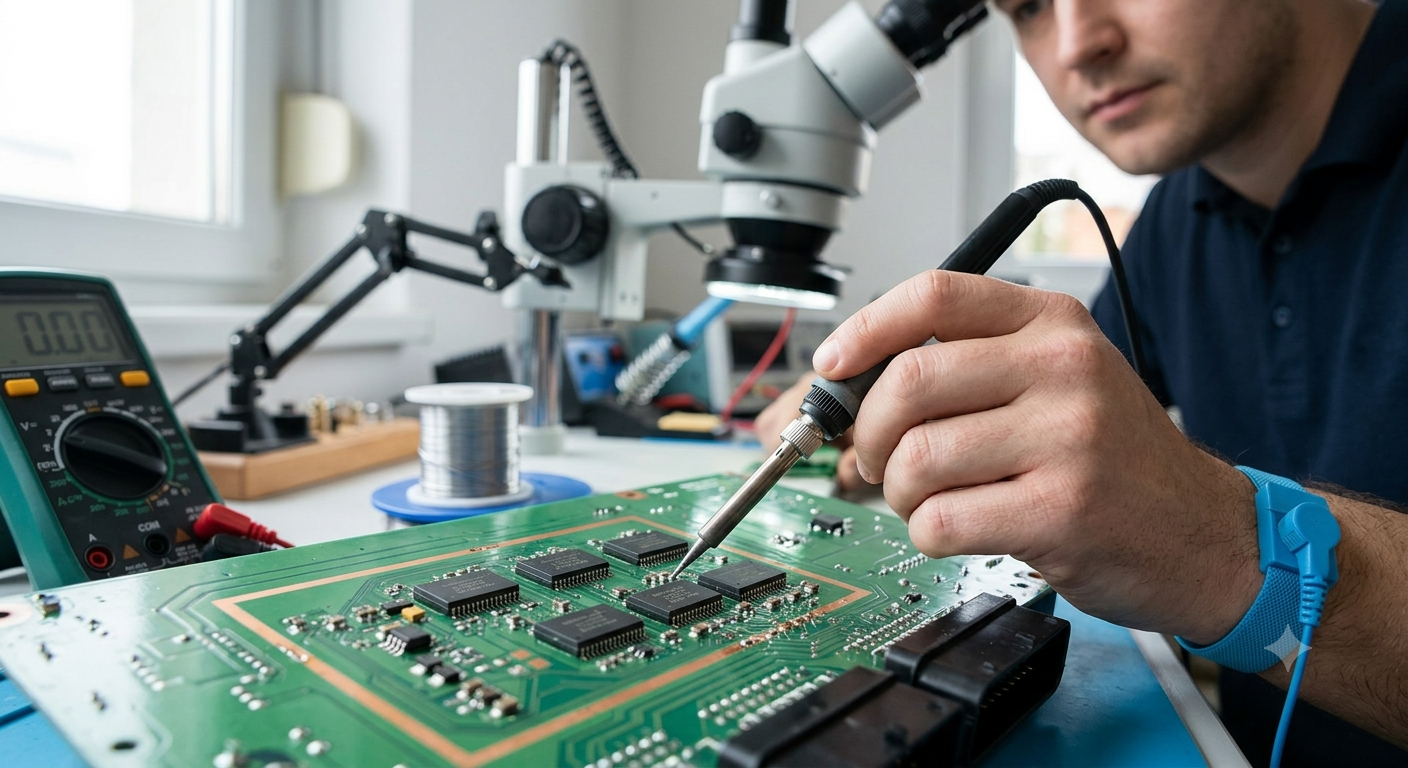
The truth? In the vast majority of cases, the hardware inside your current BCM is perfectly fine. The failure is usually limited to one or two burnt-out microchips or corroded pins on the circuit board.
The Smarter Alternative: Component-Level Repair
At BCM Express, we believe in fixing what is broken rather than replacing what isn’t. We treat your BCM like a high-end computer motherboard.
By choosing a specialist repair over a dealership replacement, you gain three major advantages:
Massive Cost Savings: You aren’t paying for the manufacturing cost of a new module. You are simply paying for the expertise required to fix your existing one.
No Compatibility Hassles: Because we are repairing your original unit, you don’t need to worry about complex recoding or “mismatched” software versions. Your car recognizes its own “brain” immediately.
Faster Turnaround: Instead of waiting weeks for a part to be shipped from a central warehouse, we can often diagnose and repair your unit in a fraction of the time.
When Should You Call an Expert?
If your car is showing signs of electrical instability, don’t ignore it. Electrical gremlins rarely fix themselves; they tend to get worse, and a short circuit in a BCM can sometimes lead to more expensive damage to other electrical components if left unchecked.
Look out for these common warning signs:
Flickering or non-responsive headlights.
Intermittent failure of door locks or windows.
Drain on your battery (the BCM “waking up” when it shouldn’t).
Dashboard error messages that appear and disappear without cause.