When a vehicle arrives at your workshop, and the diagnostic tool spits out a dozen ‘Lost Communication’ (U-code) faults simultaneously, your intuition probably points to a major failure. The dashboard is a Christmas tree of warnings, yet the car might still start and drive perfectly.
These complex network failures frequently lead mechanics down expensive rabbit holes, replacing perfectly healthy sensors or wiring looms. The real culprit is often the vehicle’s electrical brain: the Body Control Module (BCM).
At BCM Express, we are specialists in automotive electronics diagnostics and repair. Here is our insider guide to troubleshooting CAN-bus faults and understanding when BCM failure is the root cause.
The Complex Nervous System: CAN-Bus Architecture
Modern vehicles are not simply machines; they are rolling computer networks. A contemporary car may contain over 70 distinct Electronic Control Units (ECUs). For these components to share real-time data efficiently (such as engine RPM, wheel speed, or steering angle), they use a communication protocol called the Controller Area Network (CAN-Bus).
This network allows modules to broadcast data across a simple, twisted pair of wires. When everything functions correctly, the central communication hub—which is almost always the BCM—interprets these data packets seamlessly.
The BCM’s Critical Role on the Bus
The Body Control Module acts as the traffic cop for the vehicle’s ‘Body’ electronics. It coordinates:
Central locking and key fob inputs
Lighting (interior and exterior)
Wipers and washers
Security and immobilizer systems
Instrument cluster displays
Crucially, the BCM often serves as the gateway node connecting the low-speed CAN-bus (controlling creature comforts) to the high-speed CAN-bus (responsible for engine, transmission, and braking data). When the BCM fails, the primary communication channel collapses.
3 Red Flags pointing to a failing BCM (Not a Sensor Fault)
If you see these combinations, stop checking individual sensors and focus on the BCM:
1. Intermittent ‘Phantom’ Wipers, Indicators, or Horn
A classic symptom is auxiliary systems activating by themselves. If the windshield wipers turn on without input, or the horn sounds while the car is locked, a shorted internal relay or corrupted logic circuit inside the BCM is likely back-feeding power where it shouldn’t be.
2. CAN-Bus “Bus Off” and Power Loss
If multiple warning lights (e.g., ABS, Airbag, Check Engine, Tire Pressure) illuminate simultaneously, yet the car seems mechanically fine, a primary communication path is down. The BCM may be so damaged (often by water ingress) that it has completely stopped transmitting data, causing dependent modules to ‘loss communication’ U-codes.
3. Asymmetrical Electrical Failures
This is when a single, essential function fails completely, but only from one side. Examples include: a key fob that unlocks the car but won’t lock it; a driver-side window that won’t roll down but can still be controlled from the passenger switch; or the passenger-side indicators flashing correctly while the driver-side remains completely dead. If a wiring continuity check confirms the wires aren’t broken, the failure is inside the BCM’s driver circuit.
Validating the Diagnosis: Bench Testing vs. Replacement
You’ve traced the issue back to the BCM. Your standard workshop scan tools confirmed U-codes, and perhaps your oscilloscope showed erratic signals on the CAN lines. What is the next step?
The Main Dealer Trap
A main dealer will tell you that a new BCM is required, costing hundreds—if not thousands—plus expensive coding and security reprogramming at main dealer labor rates. They will rarely offer to test your existing unit to confirm the failure.
The Specialized Solution
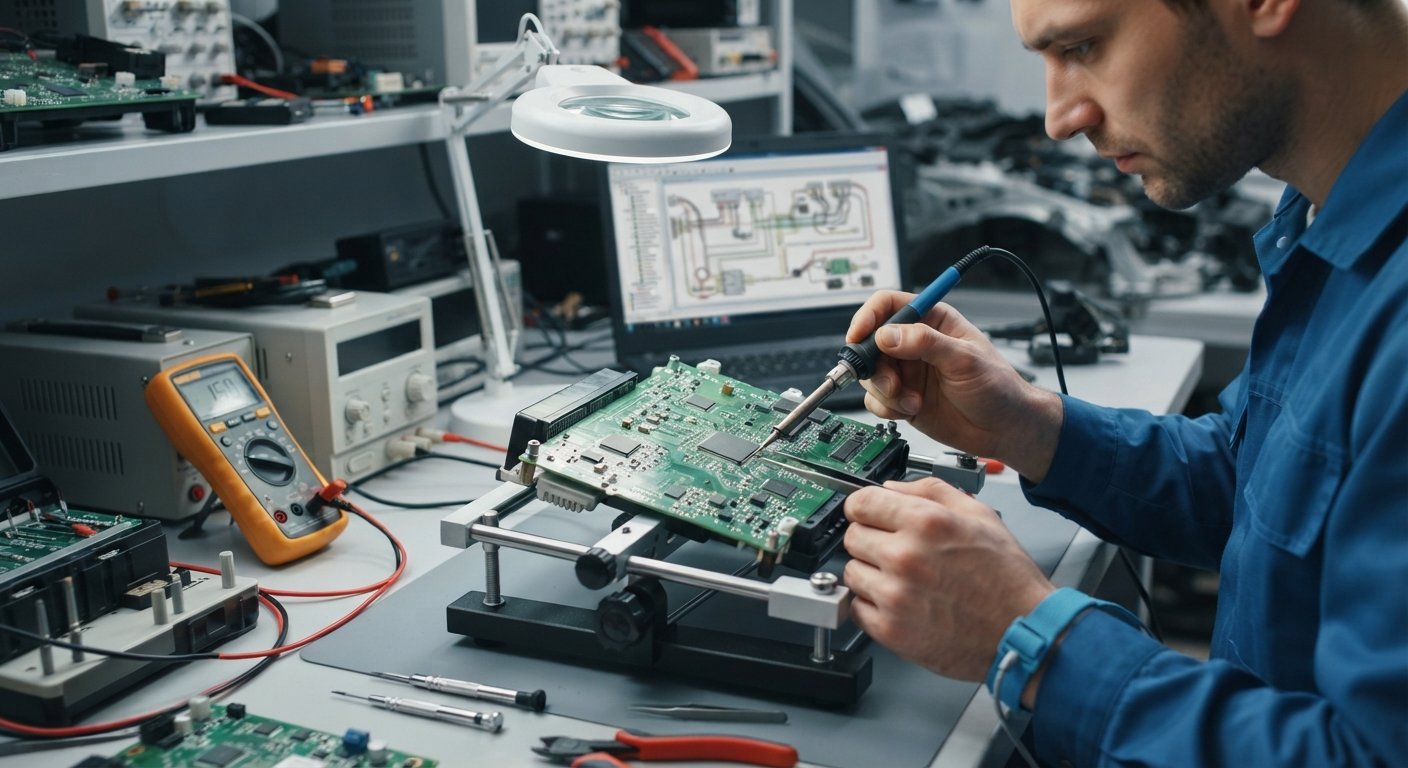
We specialize in advanced BCM diagnostics. Our technicians remove your module (often available in standard vehicle access points) and connect it to a specialized benchmark rig in our controlled electronics lab.
This bench test allows us to:
Verify the Fault: We simulate vehicle conditions and confirm precisely which output driver, relay, or communication chip has failed, eliminating the diagnostic uncertainty.
Perform Targeted Repairs: Instead of replacing the whole unit, we carry out component-level repairs, replacing failed capacitors, transceivers, or traces. This often costs less than half the price of a new unit.
Hardware Cloning: If a unit is completely beyond repair, we can extract the critical coding data (VIN, immobilizer keys, mileage) from your original board and flash it directly onto a healthy, refurbished donor unit. This ensures the replacement is 100% plug-and-play, saving you all dealer coding costs.
Stop Guessing. Start Testing.
Complex vehicle electrical faults are frustrating, but understanding the central role of the Body Control Module helps you diagnose them faster. If you encounter puzzling CAN-bus failures, electrical gremlins, or simultaneous warning lights, don’t waste time and money on unconfirmed repairs.
Contact BCM Express today. We provide professional BCM diagnostics, reliable repairs, and seamless cloning services to get your vehicle back on the road efficiently. Visit https://bcmexpress.co.uk to learn more.