
To most drivers—and even quite a few mechanics—vehicle electronics are a bit of a black box. When a car or van starts throwing bizarre electrical tantrums, the usual diagnosis is swift and clinical: “The BCM is dead; we need a new one.”
But have you ever wondered what is actually happening on a microscopic level inside that plastic box when it fails?
When you look past the warning lights and the four-figure replacement quotes, the inner workings of a Body Control Module reveal a fascinating mix of engineering vulnerability and clever micro-circuitry. Let’s take a peek behind the bench at what really goes wrong inside a failing BCM, and why component-level repair is changing the game for vehicle electronics.
The Anatomy of a Cabin Brain
Inside a modern BCM, you’ll find a multi-layered printed circuit board (PCB) packed with microcontrollers, power relays, solid-state switches, and communication chips. While the engine control unit (ECU) lives safely sealed in the engine bay or cabin firewall, BCMs are often tucked away behind dashboards, under kick panels, or near steering columns.
Because of where they live, they are uniquely exposed to the harsh realities of daily driving. Over thousands of miles, vibration, fluctuating cabin temperatures, and moisture slowly chip away at their resilience.
The Usual Suspects: Why Do BCMs Give Up?
When a BCM lands on a specialist diagnostic workbench, technicians generally see a few recurring culprits responsible for the chaos:
Micro-Water Ingress & Corrosion: You don’t need a flooded footwell to drown a BCM. A tiny, slow leak from a deteriorating windscreen seal, a blocked sunroof drain, or even condensation building up behind a cold dashboard is enough. Moisture creeps in, meets live electrical current, and initiates slow-motion electrochemical corrosion. Over time, microscopic copper tracks on the circuit board dissolve away, severing the connection between pins and processors.
Relay Fatigue and Burnout: BCMs handle heavy lifting—switching high-amperage currents for heated screens, blower motors, and central locking actuators. Every time a relay clicks, an internal mechanical switch arcs. After years of relentless use, these relay contacts can pit, weld themselves shut, or burn out entirely, leaving components permanently powered on (hello, mysterious battery drain) or completely dead.
Voltage Spikes: A failing alternator, a loose battery terminal, or a botched jump-start can send a rogue voltage spike surging through the vehicle’s network. While protective diodes try to absorb the blow, a severe surge can fry delicate logic gates or microcontrollers instantly.
The Magic on the Workbench: Diagnosis vs. Guesswork
A main dealership typically treats a BCM as a sealed, unserviceable unit—if it stops talking to the diagnostic scanner, out it goes into the bin.
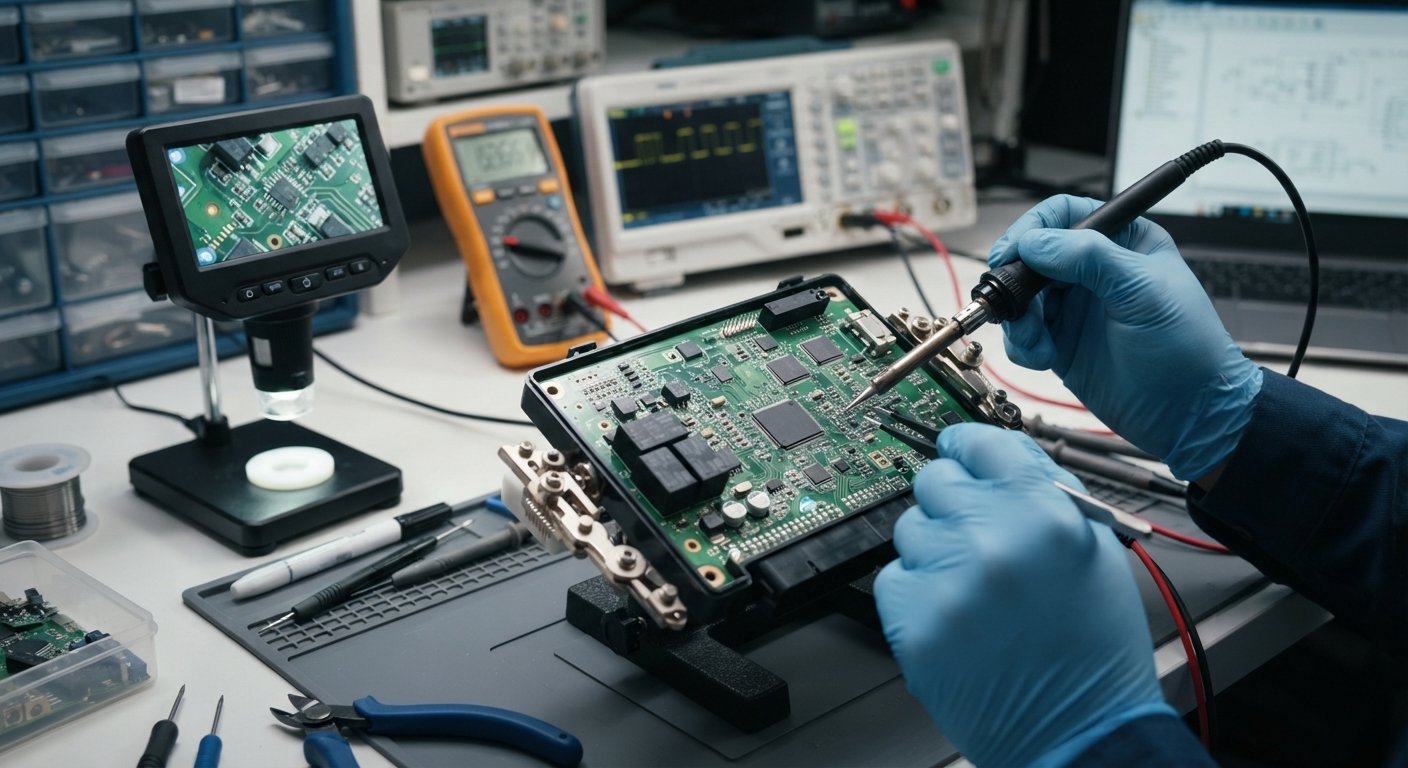
Specialist repair labs, however, treat it like surgery. Using specialized oscilloscopes, thermal imaging to spot short-circuits drawing excess power, and magnified micro-soldering stations, technicians can trace a fault right down to a single failing surface-mount resistor or a corroded IC leg.
Once the faulty component is mapped out, it is desoldered and replaced with a heavy-duty, fresh component. Afterward, the board undergoes a rigorous ultrasonic clean and protective conformal coating to shield it from future moisture.
Cloning: The Ultimate Safety Net
What happens if the actual brain (the microcontroller containing the vehicle’s unique immobiliser data and configuration) is physically fried?
This is where advanced data cloning comes in. Instead of forcing a brand-new unit to be factory-coded from scratch, a specialist can extract the exact flash memory and EEPROM data from your original, damaged BCM using specialized bench readers. That data is then transferred byte-for-byte into a healthy donor unit.
When you plug that cloned unit back into your vehicle, the ignition system recognizes its own code instantly. No towing, no main dealer software locks, and no heartbreaking bills.
Knowledge is Power
Next time your dashboard starts acting like a haunted pinball machine, remember that underneath the plastic housing is a complex circuit board that can often be rescued. Understanding what happens inside the box helps you sidestep the expensive replacement trap and keeps perfectly good hardware out of the landfill.
Got a glitchy module or electrical issue baffling your garage? Take a look at the diagnostic and repair options over at BCM Express to see how precision bench testing beats a costly swap every time.